How to Choose a Retrofit Yield Monitor for Your Combine
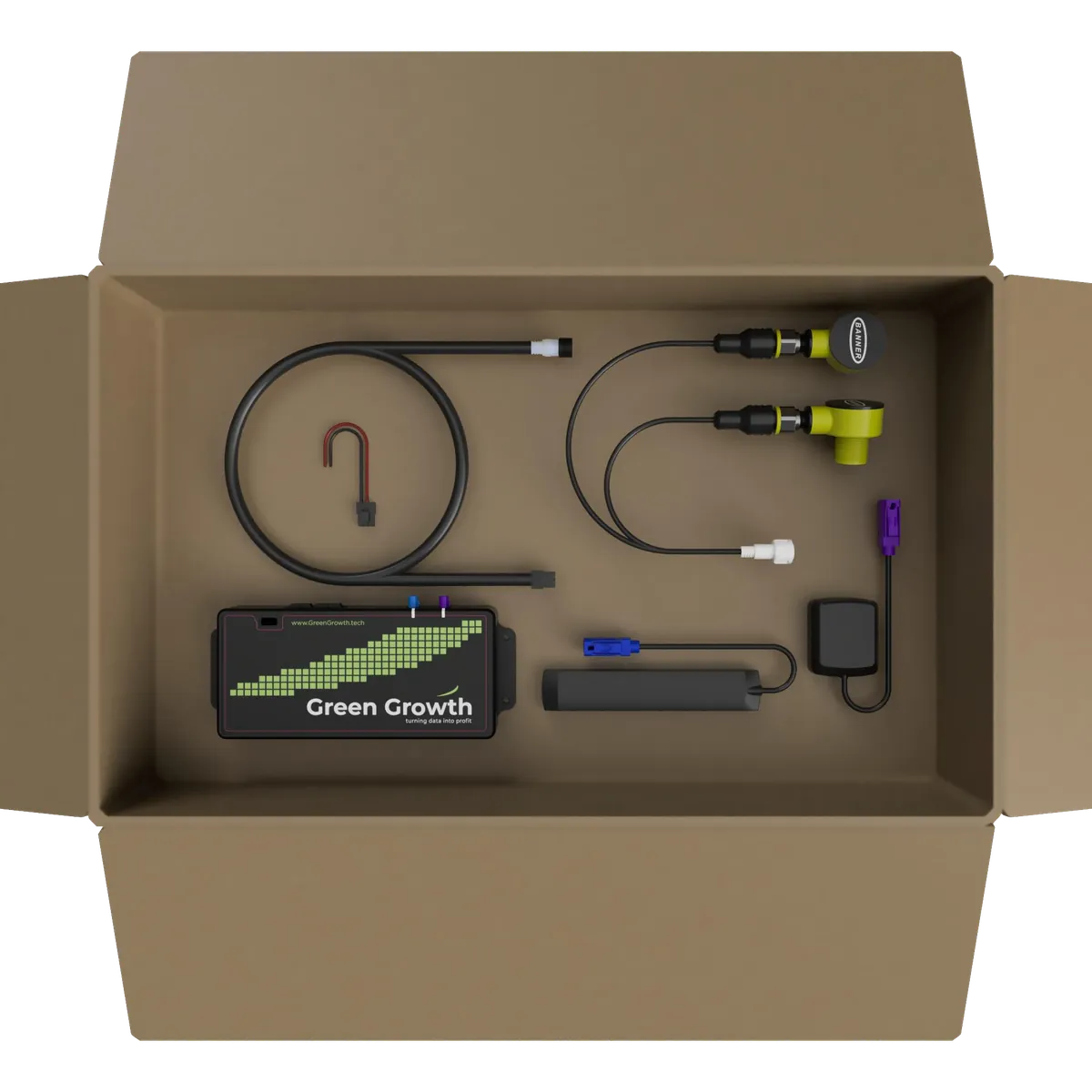
Quick answer: The best retrofit yield monitor is an optical kit with easy remote calibration that installs on your existing combine's clean grain elevator in about 2 hours, works on any brand from roughly 1995 onward, and exports your data in standard formats (Shapefile / ISOXML). Expect a one-time hardware cost plus a small annual cloud fee for data storage and dashboards — far less than replacing the machine. Avoid systems that require CANBUS integration, a proprietary cab screen, or per-field load-wagon calibration.
There is a specific moment during harvest when every farmer does the same mental math. You are sitting in a combine that runs perfectly fine—the engine is strong, the threshing mechanism is dialed in, and the headers are in good shape. But you are driving blind.
You know the yield is varying. You can hear the engine load change. You can see the grain tank filling faster in some spots than others. But you don't have the map. And because you don't have the map, you can't prove which zones are profitable, you can't write a variable rate prescription for next year, and you can't accurately measure if that new fungicide trial actually paid off.
The industry solution is usually blunt: "Buy a new combine."
But with new flagship harvesters costing upwards of €400,000, trading in a reliable machine just to get better sensors is financial suicide for many operations. This is where the retrofit yield monitor market steps in.
But not all aftermarket systems are built the same. If you are looking to upgrade your older John Deere, CLAAS, New Holland, or Case IH combine, here is what you need to look for.
1. Impact Plates vs. Optical Sensors: Which Is More Accurate?
This is the most critical technical distinction. Most factory-installed systems (and older retrofits) use impact plates. These work by measuring the force of grain hitting a plate at the top of the clean grain elevator.
The Problem with Impact Plates:
- Calibration Drifts: They rely on friction and physical properties. If the moisture changes, or the test weight changes, the force changes—even if the volume is the same. This means you often need to recalibrate for every field or variety.
- Wear and Tear: It's a physical moving part taking a beating.
- Low Flow Accuracy: They often struggle to remain accurate in low-yielding crops or when harvesting at slower speeds.
The Optical Advantage (Green Growth):
Modern systems, including Green Growth's retrofit kit, use optical sensors. These behave more like a scanner. They measure the volume of grain passing on the paddles of the elevator using light.
Why does this matter? Physics. Light doesn't care about moisture friction. It doesn't care if the grain is heavy or light. It simply sees the volume. This drastically reduces the need for calibration and eliminates the "drift" that makes old yield maps look messy.
2. Installation Complexity: Can You DIY?
Some retrofit kits require you to splice into the combine's CANBUS system, limiting them to specific newer models. Others require complex hydraulic pressure sensors.
When evaluating a kit, ask these three questions:
- Does it need to talk to the combine's computer? (Ideally, no. An independent system creates fewer error codes and works on older mechanical engines).
- How long does installation take? (A good kit should take 3-4 hours, not 3-4 days).
- Is it invasive? (Optical sensors usually just require a small hole in the elevator housing, which is low-risk).
We designed our system to be universally compatible—from a 1990s John Deere 9600 to a modern CLAAS Lexion. If it has a clean grain elevator, we can likely measure it.
3. Do You Need a Cab Screen, or Can You Use a Phone App?
Ten years ago, every new piece of agtech meant bolting another heavy, expensive screen into the cab. Drivers hate this. It blocks visibility and adds clutter.
Look for systems that use Tablet or Smartphone apps as the display. You already have a supercomputer in your pocket. Why pay €2,000 for a proprietary low-resolution screen?
Green Growth's system connects wirelessly to an app on your phone or tablet. You see the yield map building in real-time, right on the device you already own. And because it's an app, you get updates instantly from the App Store, rather than waiting for a dealer to update firmware with a USB stick.
4. Who Owns the Data — and Can You Export It?
The trap with some proprietary systems is the "Data Silo." You collect the data, but it's stuck in their format. You can't put it into your farm management software, or you have to pay a subscription to export it.
Always check if the system exports to standard formats like Shapefile (.shp) or ISOXML. These are the universal languages of agriculture.
"Your data should be portable. If a system locks your yield maps inside a closed ecosystem, it’s not a tool—it’s a trap."
5. The "Mixed Fleet" Reality
Very few farms run a single brand of equipment forever. You might have a John Deere combine today, but buy a used CLAAS next year. You might hire a contractor who runs New Holland.
If you buy a retrofit kit that only works on John Deere, you are limiting your future options. A universal aftermarket system is an asset that standardizes your data regardless of the metal paint color. It allows you to see unified yield maps across a mixed fleet.
Conclusion: Upgrade the Brain, Keep the Iron
Combines are built to last 10,000 engine hours. Electronics often become obsolete in 5 years. This mismatch is the core economic argument for retrofitting.
By installing a modern, optical yield monitor, you decouple the sensing technology from the machine chassis. You get 2026-level data accuracy from a 2010 machine. In an era of tight margins, that is arguably the smartest equipment investment you can make.
Ready to upgrade? Check out our Retrofit Yield Monitor Kit or request a quote today.
Frequently Asked Questions
Can you add a yield monitor to an old combine?
Yes. A retrofit (aftermarket) yield monitor installs on the clean grain elevator of an existing combine, so machines from roughly 1995 onward that never had yield monitoring can be upgraded without buying a new harvester. An optical retrofit kit needs only a clean grain elevator and 12V power, and installs in about 2 hours.
Does a retrofit yield monitor need calibration?
It depends on the sensor type. Impact-plate systems need repeated load-wagon calibration because grain moisture and plate wear change the reading. Optical systems measure grain volume with light and don't need load-wagon weigh runs per field, so they hold accuracy across a full harvest.
How much does a retrofit yield monitor cost?
A retrofit yield monitor is a one-time hardware purchase — a small fraction of the €300,000+ cost of replacing the machine. Green Growth's kit is one-time hardware plus a small annual cloud fee covering telemetry upkeep, data storage and the web dashboards, and pricing depends on crop type and kit configuration, so it is typically quoted per machine.
What file formats should a yield monitor export?
Choose a system that exports to Shapefile (.shp) and ISOXML — the universal formats for farm management software and variable-rate prescriptions. Avoid closed systems that lock your yield maps in a proprietary format or charge to export them.
Will an aftermarket yield monitor work across a mixed fleet?
A universal retrofit kit that is independent of the combine's CANBUS works on any brand — John Deere, CLAAS, New Holland, Case IH and others — so you can standardise data across a mixed fleet and produce unified yield maps regardless of machine make or age.
Share this article
Put your own harvest data to work
Green Growth retrofits a yield monitor to the combine or potato harvester you already own — any brand, any age. It installs in about 2 hours, calibrates remotely with no load-wagon runs, and your data stays yours. Tell us about your farm and we'll send a quote.