Good Food Needs Good Farmers. Good Farmers Need Architecture.
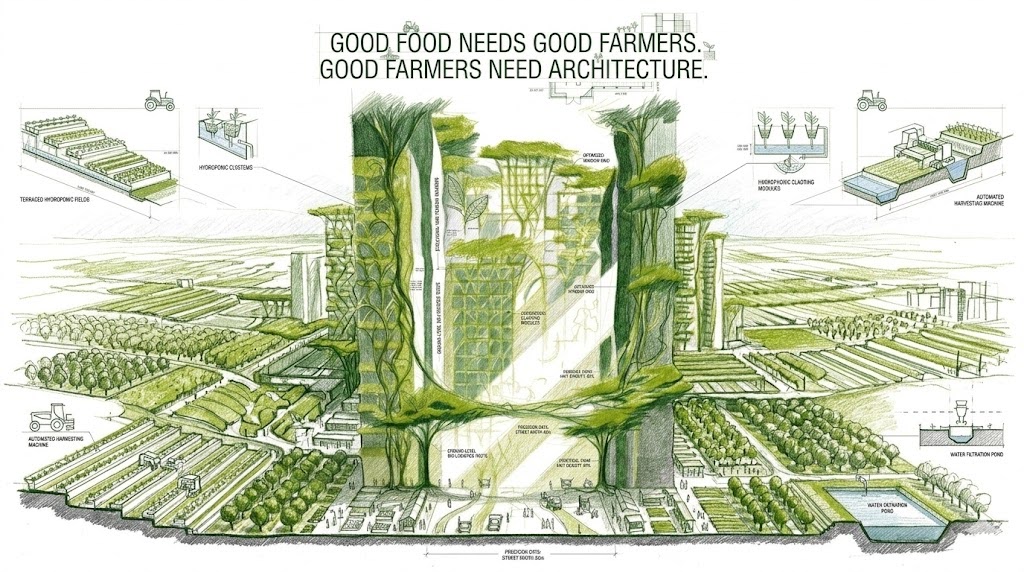
Why the Food System Needs Architecture, Not Another App
We live in an age where delivery, purchases, startups – every single solution is expected to be fast. Food joined this race early. It became packaged, standardized, stripped of identity: an industrial object engineered for shelf life rather than meaning. That is not a moral judgment. It is simply what happens when speed becomes the primary design constraint.
There is just one problem with applying that logic to food: trust does not obey the same physics. A 2025 review in Trends in Food Science & Technology maps the accelerating gap between agri-food traceability innovation and the actual trust consumers place in the systems that deliver their food. And the gap is widening.
Consider: 76% of grocery shoppers say transparency about ingredients and sourcing matters to them – up from 69% a few years ago. Six in ten global consumers want to know where their food comes from. And yet only 12% of consumers rank brands as their most trusted source for food information. In an industry built on brand equity, that number is a structural warning. The demand for trust is rising; the supply of it is not. And this quiet contradiction is reshaping the architecture of sustainable agriculture and food technology alike.
Fast Food System, Slow Human Brain
When a supply chain moves fast enough, it starts to feel frictionless. And frictionless systems tend to make people anxious, because the things we trust are never frictionless. They are slow, specific, and carried by someone with a face. Which is exactly why, as the food system became more efficient, consumer behavior quietly started bending in the opposite direction.
Farm-to-consumer e-commerce was valued at $6.8 billion in 2024 and is projected to hit $28.4 billion by 2033. In the U.S. alone, direct-to-consumer food sales already account for $17.5 billion. Regenerative product sales grew 20% year-over-year. Food Tank's 2025 analysis confirms what the figures imply: regenerative, origin-traceable production builds consumer trust in ways that industrial branding simply cannot replicate.
These are the early signals of a parallel food economy – one built not around the fastest route to the shelf, but around provenance, relationship, and the radical idea that a consumer should know who grew their food. The only actor in the entire supply chain who can deliver that idea credibly is the farmer.
Why a Farmer Beats a Brand (Even Without a Marketing Budget)
A brand needs a campaign to claim authenticity. A farmer simply has it. Origin attached to a specific field, a specific season, a specific pair of hands. In a market where everything – reviews, sustainability reports, product stories – can be generated and optimized, physical presence carries a scarcity premium that no content team can manufacture.
More than 70% of shoppers now consider sustainability and ethical sourcing important when making purchasing decisions. And EY's research on the connected food ecosystem captures the structural shift plainly: as transparency of production methods becomes a baseline consumer expectation, the competitive advantage moves toward those who can deliver their product with authentic, verifiable origin. The true origin itself.
This should be the farmer's moment. And yet.
Trust Without Infrastructure Is a Beautiful Dead End
The farmer holds the most valuable asset in the modern food chain: a trust relationship that no budget can fake. The problem is that this asset has nowhere to go. There is no scalable logistics built around individual producers. No precision agriculture data infrastructure connecting their fields to distant buyers in a language both sides understand. No market access pathway that does not quietly extract margin and dissolve the authenticity in the process.
Less than half of U.S. farmers are projected to be profitable in 2026. Cash receipts for vegetables are forecast at $520 million lower this year than last. The economics are compressing from both ends: input costs rise, market access shrinks. And the Frontiers in Sustainable Food Systems study on agri-tech adoption barriers identifies data infrastructure – or the lack of it – as one of the primary reasons small producers cannot convert their quality and trust advantage into commercial scale.
They have trust. The architecture to deliver it at scale is missing.
This is the central paradox of contemporary food markets: the actor people trust most is structurally the least equipped to reach them.
The Algorithm as Connective Tissue
Let's be precise about what "architecture" means here – because this is where the conversation usually gets muddled by excitement about "AI-powered supply chains." The right architecture does not replace the farmer's judgment. It carries the farmer's knowledge, translates it into data that markets understand, and keeps the human story intact across every link in the chain.
The food traceability technology market reached $13 billion in 2024 and is projected to grow to $45 billion by 2034. The World Economic Forum's 2025 analysis identifies this growth as driven by converging forces: regulatory pressure from food safety legislation, commercial pressure from premium buyers demanding verifiable origin, and consumer pressure from a generation that treats traceability as a basic expectation. The market is not waiting for trust infrastructure to become optional.
And the ESG Agriculture 2025 models from Farmonaut point toward what this means for investment: environmental and agricultural data is evolving into a verifiable currency. Producers who invest in credible, traceable data reporting gain an ESG asset – and that changes the economics of farming entirely. At that point, the field stops being just a production unit. The field becomes a documented, auditable source of verified value.
What the New Food Architecture Actually Connects
Person → Farmer. Farmer → Data. Data → Verified Decision. Verified Decision → Market Access.
Each link in this chain serves one purpose: making origin legible at the scale where markets operate. Industrial food stripped origin away and replaced it with branding. The new architecture reverses that logic: origin travels with the product, and the brand becomes secondary to the proof.
In practice, as The Dairy Site's AgTech 2026 report describes it, 2026 is the year when precision, prediction, and proof converge. Environmental data becomes verifiable. Supply chains become auditable from field to shelf. For sustainable food production and precision agriculture alike, "proof" is no longer a premium feature. It is the price of entry to better markets.
The Acceleration Trap: What Speed Actually Costs
Today, 44% of consumers want more traceability information specifically about meat and seafood, with the demand concentrated among consumers aged 18–34. The next generation of food buyers is asking for food they can believe in – and belief, like soil, operates on a cycle that cannot be hacked. The Innovation News Network's Sustainable Foods 2026 report is direct: health, nature, and climate have become hard commercial realities, and the organizations shaping the future supply chain are those building accordingly.
The irony is visible in the data. The faster the food system moves, the more consumers pay a premium for the one thing speed cannot produce: certainty about where something came from. The market for transparency is growing at 13% CAGR precisely because the dominant system generates so little of it.
What This Means for AgTech Investment and Who Is Building It
The opportunity is structural: build the infrastructure that lets farmers deliver their trust advantage to markets they currently cannot reach. This means yield monitoring systems that work across mixed fleets without demanding equipment replacement. Real-time yield mapping that turns raw field data into a spatial record any agronomist or sustainability auditor can read. Land productivity analytics that document how, and under what conditions – the kind of data that makes an ESG claim verifiable rather than aspirational.
This is the space www.greengrowth.tech is working in. Green Growth's universal retrofit yield monitor installs on any combine – regardless of brand, age, or generation – and converts harvest data into clean, calibrated yield maps that aggregate across mixed fleets into a single coherent spatial record. For farms managing a mix of old and new machinery across large areas, this is the foundation that makes precision agriculture possible without forcing a fleet replacement cycle. The field data that results – spatial, comparable, season-over-season – is exactly the kind of documentation that bridges farm-level trust and supply-chain-level proof. Their approach to the mixed-fleet challenge illustrates what infrastructure-first thinking looks like in practice.
According to WBCSD's Future-Proof Agriculture analysis, regenerative agricultural investment delivers returns ranging from 2x to 14x. Those returns go to companies building systems. The distinction, in 2026, is increasingly easy to spot.
After the Product Hype: What Remains
The tech industry's current obsession with shipping platforms and apps will cool, the way every hype cycle does. When it does, the question every food system will have to answer is the same one it has always avoided: does the person who grew this still exist in the story by the time it reaches the plate?
If the answer is no, the system has failed – regardless of how many features it shipped or how many sustainability certifications it collected.
If the answer is yes, someone made a deliberate decision to build food traceability infrastructure that carries the producer's story forward rather than replacing it with a brand narrative. That decision is a design philosophy before it is a technology choice. And the companies that understand this – those building sustainable farming data layers that serve farmers as much as they serve markets – will define what food means commercially over the next decade.
The human being is still the only thing people truly trust. Trust in food always traces back to a face, a field, a specific place on the map. The infrastructure's job is to make that traceable at scale – not to erase it in the name of efficiency.