Control That Listens: Why Smart Irrigation Is an Act of Care
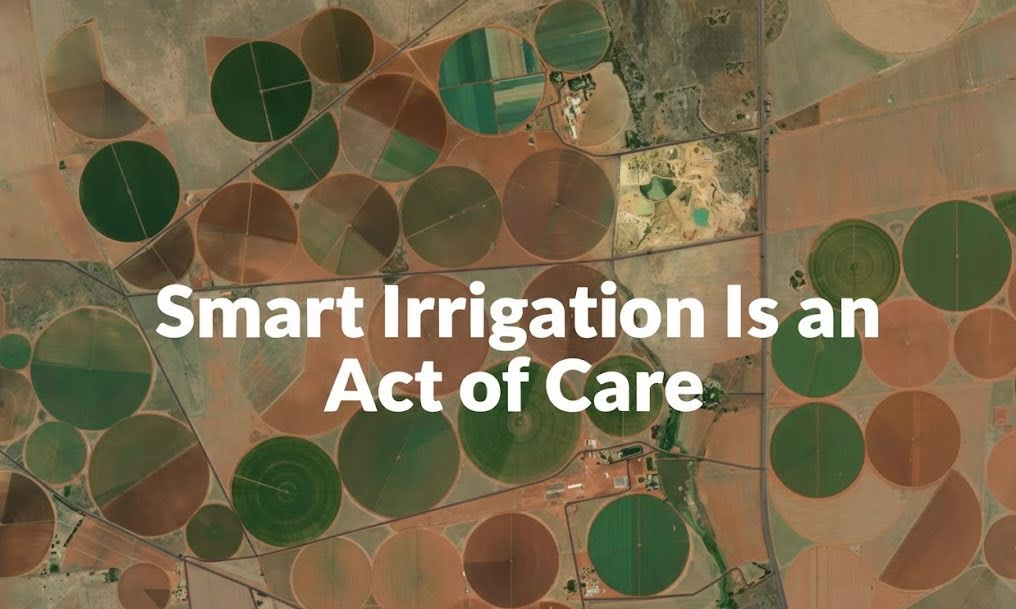
A field has never been just a flat surface under an even sun. It is a complex, living tissue woven from water, soil, plants, and history, where every square meter "breathes" in its own way. What we are used to calling "field control" has often turned out to be an attempt to subdue the land by force, ignoring the fact that nature does not surrender without a dialogue.
True collaboration is born where control transforms into care.
Modern agriculture has long outgrown the stage of "praying for rain" and heavy lifting. Today, it is the territory of data and interpretation. Technologies of recent years from GPS and satellite imagery to sensor networks and computer vision are revealing a previously invisible density of life within every hectare. It is precisely this granularity that forces us to rethink the very concept of management.
The Green Growth team set itself an ambitious task: to help the farmer to understand their constant variability. And it is no secret that the key to this understanding, just as it was thousands of years ago, lies in the realm of the right dialogue.
The Illusion of Uniformity: Why Old Control Doesn’t Work
Traditional irrigation systems, especially center-pivots, have conditioned farmers to the idea of uniformity: water is distributed in a circle, in equal steps, with identical rates. This approach was the industrial standard, but it ignored a fundamental fact: the field is not homogeneous.
Soil type, root depth, water holding capacity, past stresses: all these factors turn a plot into a dynamic system with a million micro-zones. Average irrigation is an attempt to "paper over" these differences rather than understand them.
Research from Sustainable Agricultural Water Systems Research (Davis, CA) shows that systems based on evapotranspiration (ET) data and the Crop Water Stress Index (CWSI) can explain up to 73.6% of spatial variability in orchards. This means that nearly three-quarters of the differences within a field are not chaos, but specific signals that need to be read and used as a map for management.
From Dictation to Dialogue: Technology as Empathy
So, what is control in the old sense? It is measuring and rigidly regulating. And what is care? Care is the ability to listen and respond. Here, the technological shift becomes philosophical.
Precision irrigation today is a management system that measures, analyzes, and adjusts its actions in real-time, as if conducting a continuous dialogue with the growing crop.
In agrarian reports for 2024–2025, the focus has shifted to VRI (Variable Rate Irrigation) technologies, where water is applied precisely, strictly according to the needs of a specific zone. The University of Nevada, Reno confirms: targeted irrigation based on sensor data reduces water consumption by ~20% with minimal impact on yield. In a world where, according to Water Scarcity data, water shortages are becoming the global challenge of the decade, these 20% are a matter of farm survival.
Data Is the Language of the Field
In this paradigm, data becomes context. Yield maps, heat indices, plant stress indicators – all are tools for restoring the logic of the field in time and space.
When data is gathered from disparate sources: machinery, satellites, weather stations and assembled into a single spatial language, the field begins to speak coherently. This language removes "digital fatigue." Instead of a chaos of spreadsheets, the farmer sees a story: where water worked effectively, where it was wasted, where the plant experienced stress, and where irrigation was excessive. This is critically important because the effect of water is always delayed. Without context, cause and effect are impossible to link.
When data is collected into a unified model, it becomes a full narrative of the field: what happened, why, and what can be changed in the next cycle. Such information restores trust. Technology here works as the highest form of care: it enables decisions that minimize intervention where it is unnecessary and reinforce it where it is needed.
Technology Is a Way to Remain Human
The climate is changing, markets are tightening, and resources are becoming more expensive. Simple management using "man-made crutches" no longer works; it requires an understanding of living systems. In this new reality, rejecting technology is a step into blindness.
Instead of asking the old question, "How do I force the field to yield?" modern technologies suggest asking: "What exactly is the field saying right now, and how can I help it?"
This is how control turns into care. And it is this transition from domination to attentive listening that determines whether agriculture will be sustainable tomorrow.