Computer Vision in Agriculture: From Seeing to Interpreting
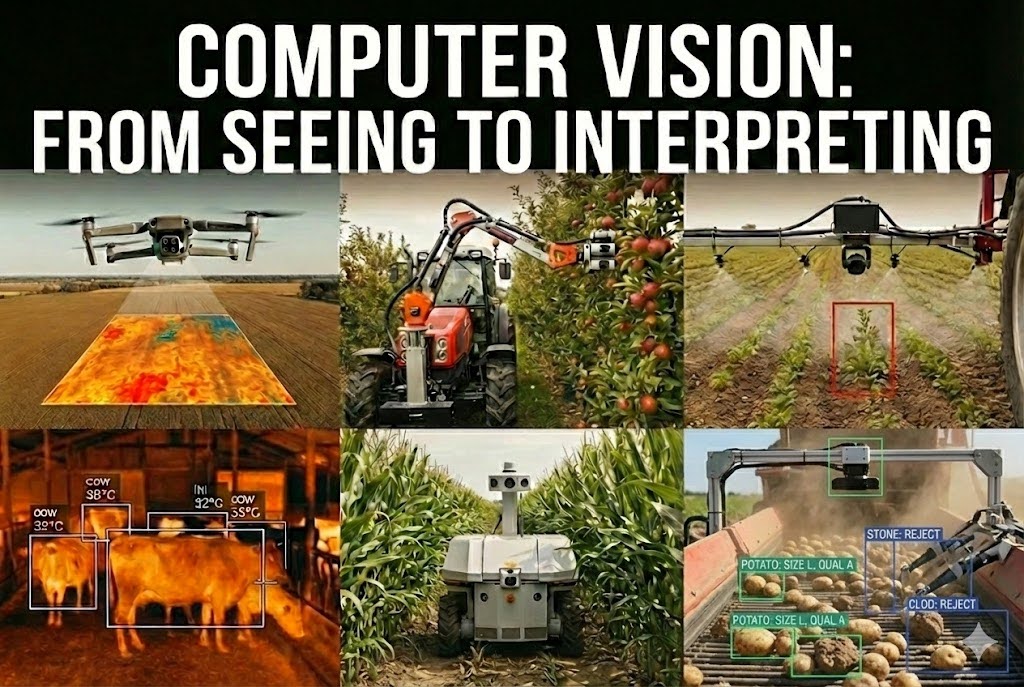
Why Computer Vision Is Quietly Changing Farming
Farming, despite what polished investor decks like to claim, is not a laboratory experiment. It is uncertainty that has taken physical form. Harvest simply strips away the covering, exposing everything in bright, unforgiving daylight.
A workday in the field does not begin when the diary says so, but when the crop is ready. Decisions are made in dust and fatigue: on the verge of realizing that nature never received the memo about “efficiency.” Every part of a field behaves differently, whether you like it or not. This is agricultural reality, confirmed by contemporary agronomic research: persistent intra-field variability that precision agriculture tools still struggle to manage. And this is not the opinion of a single author. Read the research.
Computer Vision Is Not Just Another AI Widget
Precision agriculture arrived with a certain swagger. Replace intuition with data. And it would be unfair to say it doesn’t work at all. It clearly helps: more granular yield detail, more precise input application, more defensible decisions – all built on real sensor data.
But there is a turn.
Today, farms have more data than ever before and, ironically, less clarity about what that data actually means. Metrics have become a substitute for context rather than a complement to it. Average yield figures obscure the very spatial variability farmers deal with day after day, a problem that recent research in precision agriculture explicitly identifies as one of the field’s core challenges.
Among practitioners, this phenomenon has a name: digital fatigue – data overload without interpretative coherence. Operators juggle multiple interfaces. And the growing mass of data begins to resemble interference rather than insight.
Let’s be clear: the problem is not that agriculture adopted technology too quickly. The problem is that it was sold as a tool of control, when the real challenge was never control at all, but making sense of chaos. This is precisely the point where artificial intelligence becomes relevant as a tool for understanding complex, living systems.
Enter Computer Vision: Quietly, from the Side
Cameras began appearing on drones, tractors, and harvesters. Today, AI algorithms identify crops, count plants, detect pests, and flag diseases at early stages – capabilities consistently highlighted in Review of Computer Vision and Deep Learning Applications in Crop Growth Management.
What makes computer vision fundamentally different, however, is that it starts with no abstraction, but observation.
Traditional analytics compress the world into tidy numbers. Computer vision preserves spatial truth: scale, calibration, flow, density, gaps, irregularity – exactly the things a farmer learns by walking a field on foot.
In this sense, computer vision is about one simple question: “What is happening right now?”
And that distinction matters, especially in an environment as variable as agriculture.
Unlike satellite imagery that hovers above the field in abstraction, ground-level vision sees reality as it is. Cameras mounted on machinery operate in the same dust, the same shifting light, the same shadows and chaos that humans do.
And this, strangely enough, is their strength. A clear illustration of this shift can already be seen in practice. This video shows how AI, drones, and computer vision are being used directly in real farming operations from ground-level monitoring to automated field analysis, as working tools on actual farms:
The FUTURE of Farming: Top Farming Tech Advances in 2025–AI, Robotics & Sustainable Agriculture
Seeing Isn’t the Same as Understanding
And here we reach another crucial point. Seeing is not enough. You can see yield flow, sensor-detected losses, biomass maps. But unless you understand why certain zones underperform and what a given pattern actually means, you remain stuck with reactive guesses.
Many computer vision systems capture reality… But fail to translate it into an agronomic language that leads to actionable decisions. Without a shared interpretative layer, data remains observational, useful in isolation, weak in synthesis.
To move forward, agriculture must treat computer vision as a sensor layer within a broader interpretative framework.
This is where systems of a different class begin to emerge. Instead of forcing farms into rigid standards, they take agriculture’s inherent heterogeneity as their starting point. Mixed fleets? Accepted as reality. Variability? Assumed.
This is precisely where Green Growth operates – as an interpretative layer built on top of existing operations. It does not require replacing equipment or forcing fields into a single model. Instead, it collects different signals from different machines and sensors and translates them into a unified spatial logic that remains comparable across seasons, crops, and equipment configurations.
In this approach, “raw” computer-vision data stops being a collection of isolated numbers. It becomes a coherent field-level model – one where data from any tractor, any camera, any season can be read together. Complexity becomes legible, and that changes everything.
Most importantly, trust in data begins to return. When information is consistent, it becomes usable. And when it becomes usable, it becomes valuable. This is an infrastructural shift. And in agriculture, infrastructure matters far more than flashy features.